
Chasing Argyle

Over the last few months, I have been playing with putting woven patterns onto knitted fabric. Originally I was working on 2 colour reversible designs but got distracted and started chasing the argyle motif. This is how I got to an argyle motif that I am happy with.
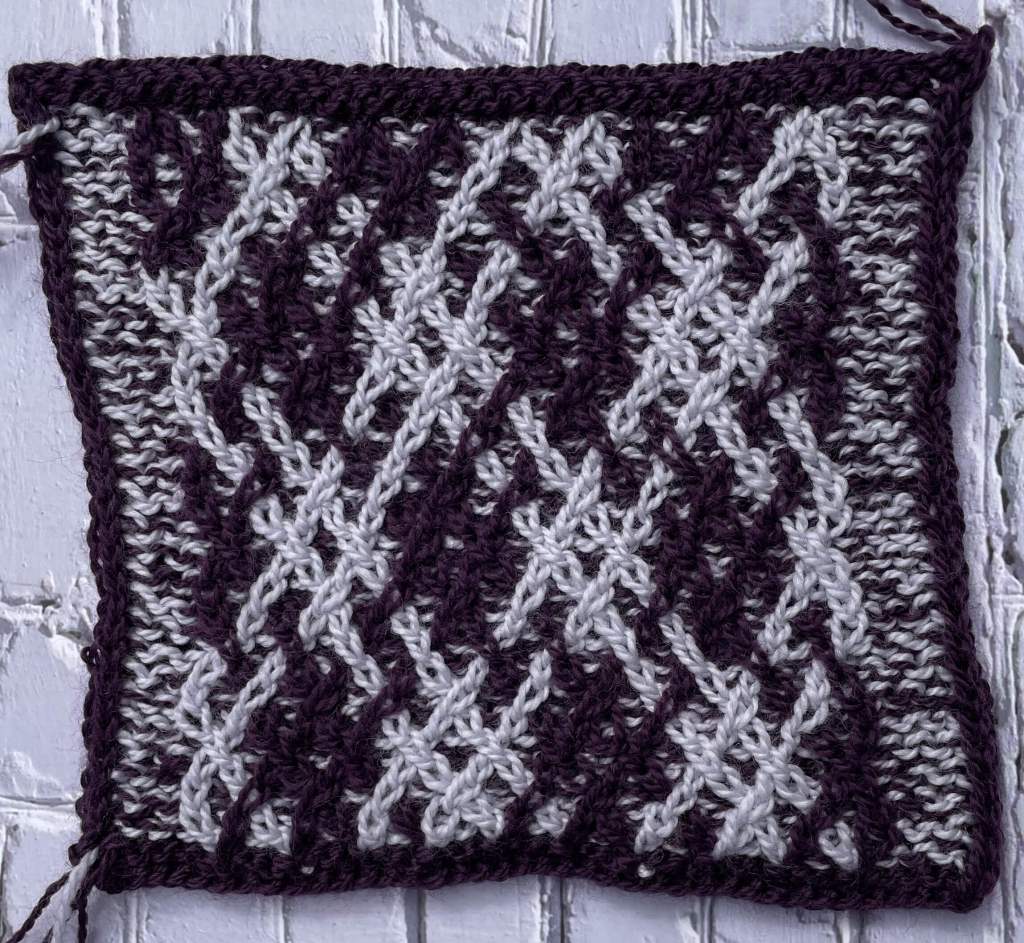
(#1) Reversible 2 colour fabric with 1 stich wide design elements, tabby weave: The motif on this side was supposed to replicate a houndstooth weave. I didn’t like how it turned out but the diamond shaped sections reminded me of the coloured diamonds on argyle. I used a tabby weave structure (every cable goes over/ under/ over/ under the cables that it crosses).
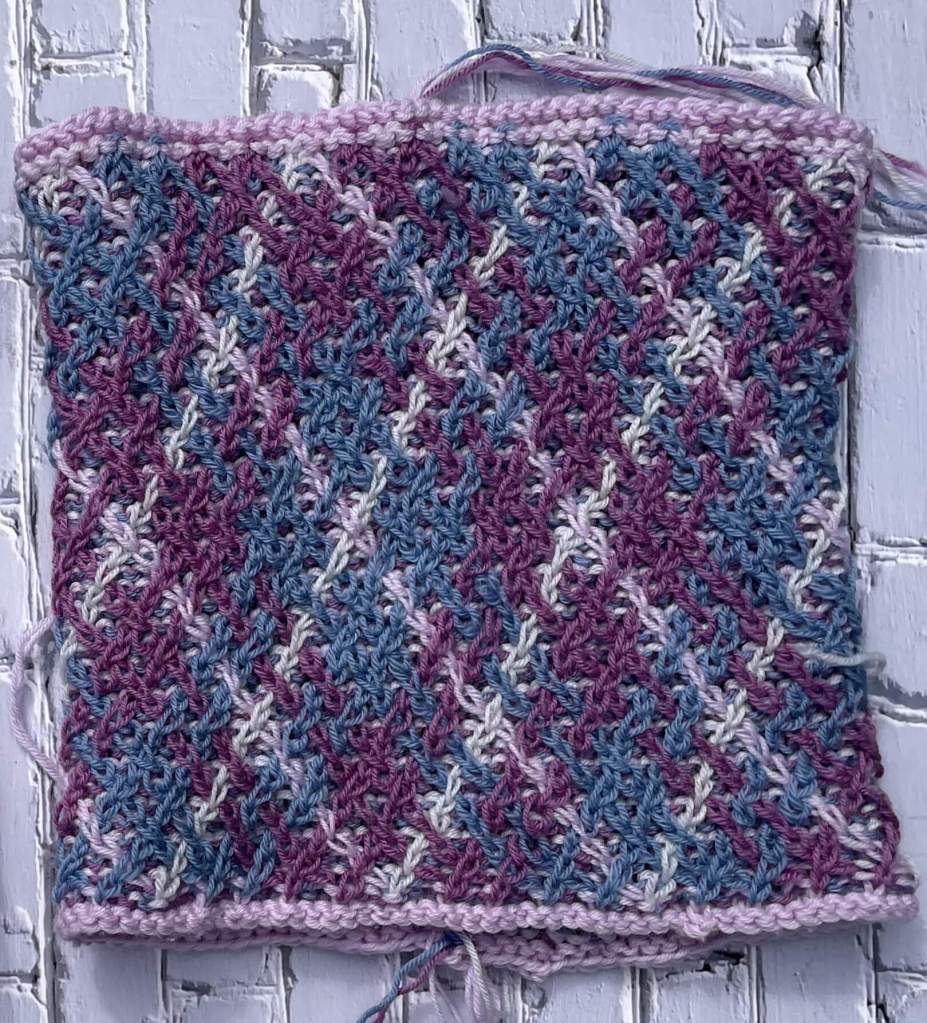
(#2) One sided 4 colour with 1 stitch wide design elements, tabby weave: This is one sided because I don’t know how to put 4 colours onto one side of the fabric and also make it reversible. This is knit with a marl. It took me a while to figure out how to place the colours — all the colour placement is done in the setup rows.

I see the argyle in this piece but I felt that the lighter colours forming the diagonal lines broke up the diamonds too much.
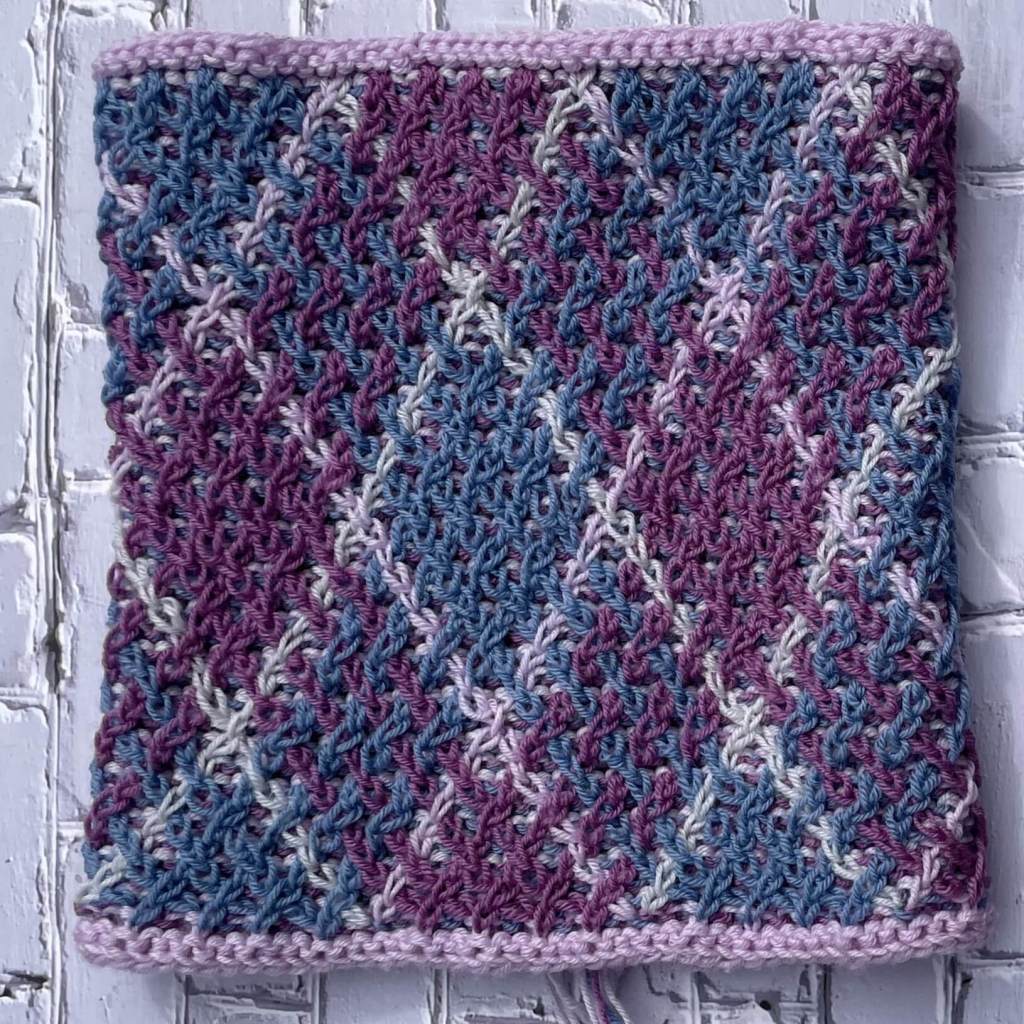
(#3) One sided 4 colour with 1 stitch wide design elements, tabby weave: This is very similar to #2 but I moved the placement of the lighter colours. I really like this piece but I didn’t think it got me closer to argyle.
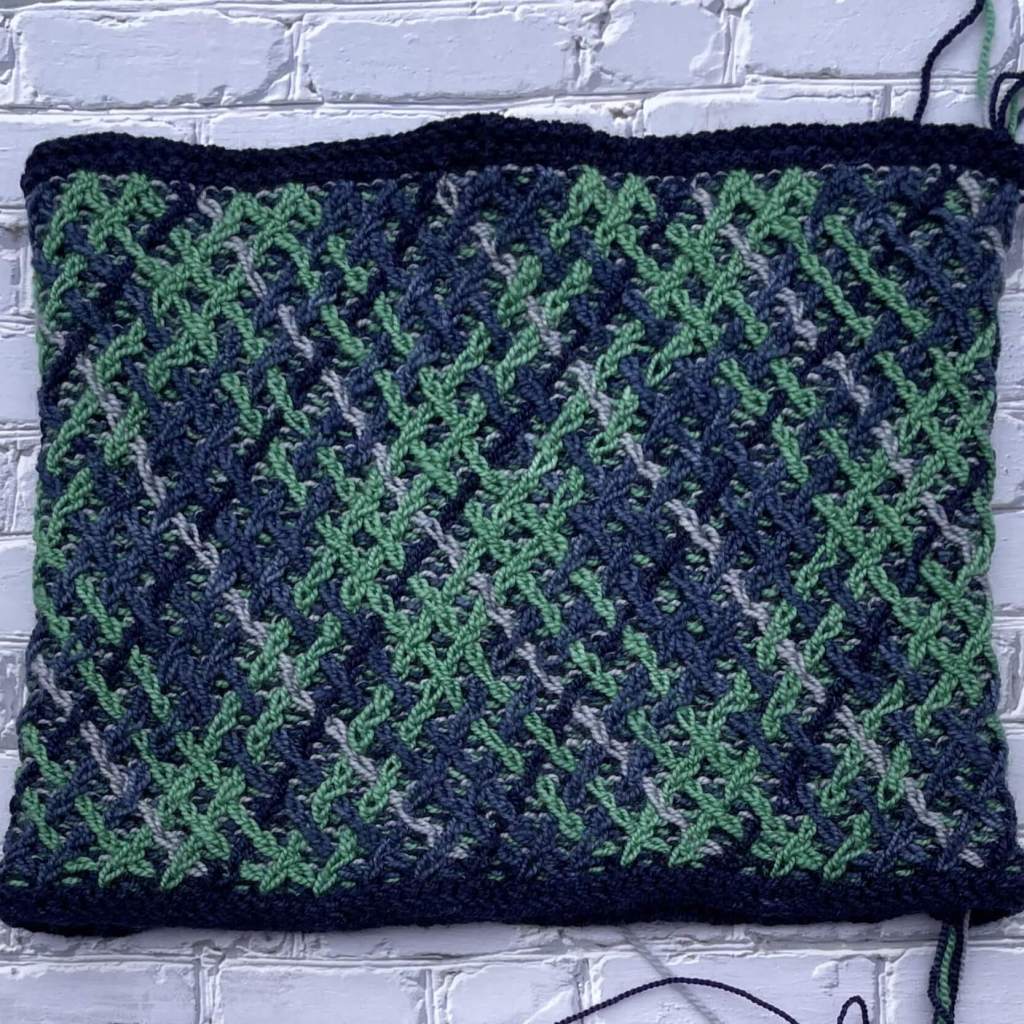
(#4) One sided 4 colour with 1 stitch wide design elements, tabby weave: Then I thought that maybe the problem with #2 was the colours that I chose. This one is the same with different colours.

Do you see the argyle in this?

After this piece, I wanted to try a new approach.
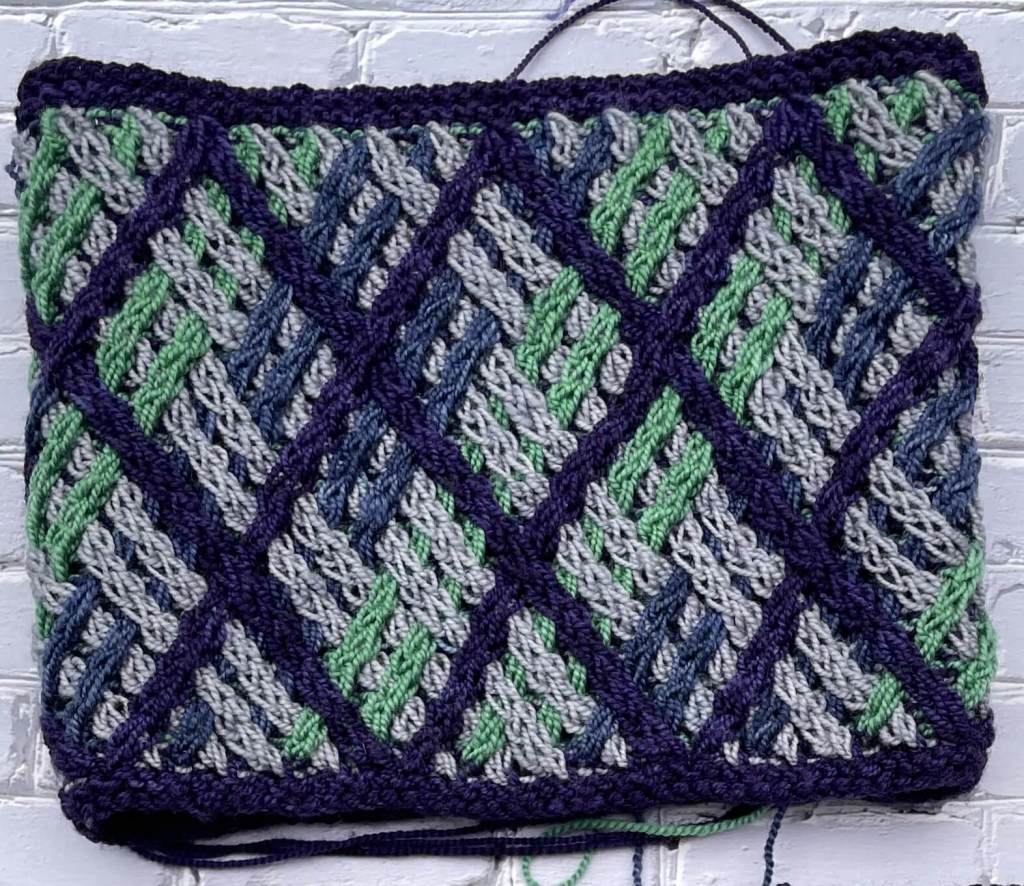
(#5) One sided 4 colour with 2 stitch wide design elements, different weave structure: I switched to 2 stitch wide design elements because I thought it would do a better job of hiding the marled background and help the diamond feel more solid.

Instead of having mixed blue/green diamonds, I moved the grey to become a 3rd colour of diamond. The set up row colour placement changed significantly.

The cables no longer use a tabby weave structure (that is, they don’t go over/under/over/under). Instead the cable in the colour of the diamond, crosses in front. Question to weavers: does this weave structure have a name?

(#6) One sided 4 colour with 2 stitch wide design elements, unknown weave structure: I thought that #5 worked well but that the diagonal lines were too dominant. So I increased the size of the coloured blocks and kept the diagonal lines the same (hence the very large swatch).

The other change was that in #5, the grey & purple were worked on the purl rows and the blue & green were worked on the knit rows. As many of you know, I do most of my designs over purlwise garter because this helps the design elements pop more.

So I switched the grey & purple to the knit rows so they popped less.

Thoughts:

I think the 2 stitch wide designs will more closely replicate weaving as it hides the background better.

I had plans to try all sorts of different weave structures but now realize that my knits might be enormous! Each cable on my knits represents one warp or weft thread. I don’t know how weaving gauge is measured but I get only 7 cables over 4 inches using fingering weight yarn.

This kind of knitting is fairly slow. It is extremely heavily cabled. I love cabling so this isn’t a problem but I’m not sure other knitters will have the patience for this.

The fabric is basically super dense cables — super squishy. Quite thick. Because the layers of fabric (like in Fission knitting) are loosely connected together, it maintains a very good drape despite its heavily cabled construction. Scarves & cowls would work well with this fabric but might not be large enough to show the large motifs.

What are you thoughts?:

I am really excited about working on this kind of knitting. It felt really good to write this and document why I did things. I would welcome your input. Would you have tried different things?

I am lacking in weaving knowledge. I welcome all feedback and would especially like to hear from weavers. I wonder if I tried things here that a weaver would know wouldn’t work. I would be also very interested in how a weaver would have approached this.

Thanks for reading this!

Leave a reply to Nicole Cancel reply

18 responses to “Chasing Argyle”

  1. Mary, these are all stunning–who would have imagined you could do this with knitting? I especially love that last one!
    I am not entirely sure I understand the difference regarding the knit/purl rows in the last two examples. Does moving the grey and purple to knit rows mean the blue and green are now on the purl rows? And you made that change because you wanted the blue and green diamonds to be more prominent?

    Like

    1. Yes you are understanding correctly.
      The background of this is garter so I need to choose which 2 colours to work on the knit rows and which to work on the purl rows. Cables worked on purl rows will pop more (this is why my reversible knits are usually over purlwise garter).

      I didn’t want the purple to pop so much & I wanted the blue and green to pop equally.

      Hope that makes sense.
      Mary

      Like

  2. O my goodness, I love double knitting, I love cabling and I love argyle – so I will be following your progress on this.

    Like

    1. Thank you for your interest.

      Like

  3. Oh Mary, solo puedo decirte que es espectacular este tejido. Siempre me ha gustado el tejido en telar y esto es asombroso. Cuando logres un producto final estarΓ­a encantada de ser tu tester πŸ€—

    Like

    1. Thanks Gloria. When it is ready I would be happy for you to test.

      Like

  4. Wow….so impressed with them all. I’m not a weaver but what you have accomplished with knitting is amazing. For me #2 looks very argyle and I also love #5.

    #1 looks like a more modern version of houndstooth….so if you aren’t a huge lover of traditional houndstooth this might really appeal to you. Given the work looks basically like 1×1 cable I don’t think the amount of cabling would be onerous as you would soon learn to do it without a cable needle.

    Like

    1. It is interesting. I didn’t think #2 looked argyle-ish enough which is why I continued on. But yesterday I showed these swatches to the yarn dyer I am working with and she said it was definitely argyle. #2 is so much easier to knit than #5.

      Interesting that you can see the houndstooth in #1 too. That is the weave structure I was going for. I think the reason it isn’t more distinctively houndstooth is because we see to much of the background fabric. I have done this pattern again with 2 stitch wide cables to hide the background & it looks much more like houndstooth

      The 1×1 cables are much faster to work than the 2×2 ones.

      Thank you for this feedback!

      Like

  5. I believe the weaving term is β€˜floats’ where you go over or down more than one warp. There is also a weaving technique called overshot that may fit.

    I did find this towel pattern (one of two) that is tabby (plain) weave and looks like your piece without the strip that would turn it into an argyle pattern.
    https://www.therogueweaver.com/new-products/colourandchenilletowelpattern

    Like

    1. That is interesting that it is called floats. I was kind of thinking of it as a float because if this was woven, there would be a longer, unanchored thread that might get caught on things (like floats in stranded knitting).

      I will look up overshot.

      That towel is so pretty. I do love that in weaving you can incorporate so many colours. Currently I don’t know how to get past 4.

      Like

  6. Hi Mary, all your examples are beautiful but I like #3 and #6 most 😊
    When I first saw your swatches I tough that it would look great as simple 4 ractangulars pullover – especially the 6th one (with finishing in the color of diagonal lines: cuffs, ribbing and neck band/turtle neck) or with just front knitted with the pattern and the rest one color

    I would gladly test knit for you
    Marta

    Like

    1. I’m glad you like them Marta
      I am starting to think about creating a garment. The idea of sizing and shaping are scaring me a bit….i think my first try will be very close to rectangular pieces sewn together β€” I’m still in the thinking phase

      Like

  7. I don’t know anything about weaving but I love #6

    Like

    1. I love 6 as well. It is definitely the most complex to knit.

      Like

  8. Oh my! This is spectacular! I love all the swatches but #6 is my favourite. Slow knitting is not a problem when the final result is bound to cause gasps and applause πŸ™‚
    I think home items would be lovely – blankets and cushion covers.
    A ruana would be great too. Basically a rectangle with an opening in the center, it can be made with two long stole-like pieces sewn together. That would solve your concern about a scarf not showing the motif enough.
    Sorry, I don’t know the weavers’ jargon at all (self-taught, I only use an inkle loom to make bag straps!!)

    Like

    1. Hi Sylvie.
      I want to get an inkle loom — to temporarily satisfy my desire to learn weaving (maybe I won’t be so tempted to get a full size loom that way).

      I have been thinking about a ruana — I have to think about sizing…

      I love 6 as well. I know you are a very patient knitter & the slow knitting wouldn’t scare you off. Thanks for you thoughts.
      M

      Like

  9. Mary Lee Garrison Avatar

    Weavers usually talk about ends per inch & picks per inch, ends being the number of warp threads across the width of the piece & picks being the number of weft threads (times the shuttle is thrown through the warp). A 12″ wide piece sleyed (set up to weave) at 12 epi would have 144 single threads across its width. For a simple plain weave fabric that was balanced – not hole-y or biased – you’d pass the weft through & beat to get 12 picks to an inch as well.

    Like

    1. Hi Mary Lee,
      Thank you for that terminology. I am learning about weaving in a untraditional way so I don’t have all the words to describe my work to a weaver (which I would like to be able to do). I have some books and lessons planned & I am looking forward to learning.
      Happy Holidays.
      Mary

      Like

Leave a reply to Nicole Cancel reply